
Difference Between Wolf and Dog
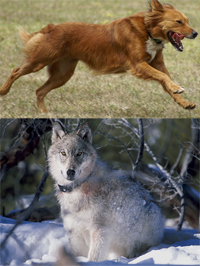 Wolf vs Dog
Although wolves and doges contain similarities in some aspects, but one came across more variations between the two. Wolf is basically categorized only as a wild animal as compared to the dog which is well known house Pet, for the reason that dog was domesticated so they would not act like wolf. Wolves being wild animals are not suited to live with people or to make a close relation like dogs. Unlike wolves, dogs have demonstrated themselves as a good companion and good Pet.
According to Biological classifications, Zoologist and Taxonomist include the wolves in family ‘Canis Lupus’ whereas dogs are placed in family ‘Canis familiaris’ of Kingdom Animalia. In addition, there is a one of the most visible difference amongst both is a variation in physical appearance and structure. The wolf occupies a large body dissimilar to dog that is smaller in size than wolf. Muzzle of the wolf is also founded to be longer as compared to most of dogs.
When it comes to compare their legs, the wolf comes with longer legs, larger feet and a wider cranium than the dog. Wolves are well recognized hunters but a dog lacks this specialty because of its domestication. Wolves are much physically powerful than dogs. Despite the fact that wolves and dogs have the equivalent number of teeth, the differentiation is definite. The teeth of wolves are adapted for hunt. Unlike the dogs, the wolves have stronger molars, which help it to crush largest bones. Wolves include specific teeth used for holding onto their prey. Dogs can feed on dog food/kibble while wolves are carnivores and they need raw meat.
Wolf is considered to be cleverer than the dog and wolves are more conscious of their surroundings than the dogs. Dog barks while a wolf only howl , however dogs easily learns to howl and wolf can only make a sharp muffled sounding bark but wolves rarely do this.
Wolves always love to be in crowd, even if it is a group of two or more. But dogs do not used to live in groups and they time and time again are seen combating one another.
When it comes to their sexual behaviours, the female dogs come into ‘heating period’ twice a year while female wolves get into ‘season’ only once a year. It has been noticed that only the alpha female wolf or head female wolf is permitted reproduction in wolf habitation.
Some major differences can also be seen in skeletal structures of the two, asa wolf has longer legs with large feet and wider skull and narrow chest while a number of the dog’s species don’t possess this type of skeleton. Wolf has an edge of running and moving fast with the help of their particular skeletal structure. During trotting wolf’s back legs move backward and forward in the same line like its front legs, on the other hand dog places its back legs between its front legs during walking or running hence making the slow motion of dog as compared to faster wolf.
Summary:
~ Dog is basically a domestic pet and wolf is a wild animal.
~ Wolf and dogs comparatively belongs to different families in Kingdom Animalia.
~ Intellect level of wolf is higher than dog.
~ Mostly dogs found to quarrel each other as compared to wolf incase their survival depends on living in packs.
~ Dog barks while wolf seldom and wolf paces, a dog trots.
~ A wolf is a good hunter where as a dog has lost this aptitude due to its domestication.
References:
Animal Taxonomy, Animal Zoology (A course book of Graduation Level in University of the Punjab Lahore Pakistan).
- Difference Between CNBC and Fox Business - October 3, 2011
- Difference Between Distilled Water and Boiled Water - September 30, 2011
- Difference Between McDonalds and Burger King - September 30, 2011
Search DifferenceBetween.net :
 Email This Post
: If you like this article or our site. Please spread the word. Share it with your friends/family.
Email This Post
: If you like this article or our site. Please spread the word. Share it with your friends/family.


These “facts” largely seem to be things the author believes, rather than true facts.
Dogs are indeed the result of the domestication of the gray wolf, not all dogs remain domesticated. Feral dogs are dogs that have returned to the wild, and are now considered wild animals. An example is the Australian Dingo.
The domestic dog’s scientific name is “canis lupus familiaris”, not “canis familiaris”. The dog a sub species of the gray wolf.
“The wolf is bigger than the dog” – Great Dane, English Mastiff, Irish Wolfhound – all larger on average than the Gray Wolf.
“A wolf is a good hunter but a dog has lost this talent because of its domestication” – Again, it greatly depends on the breed. Wolf vs Maltese, wolf wins, hands down. Wolf vs Elk-hound, well, that’s a different game. Some dog breeds are superb hunters, because that is the trait they were bred to do. Many breeds of dog hunt every bit as well as wolves. Feral dogs can be formidable pack predators.
“. . . dogs do not love to live in packs . . .” – Patently false. Dogs have just as strong a pack instinct as wolves, which is one of the reasons they make such loyal pets. Feral dogs will naturally form a pack due to this instinct. How do you explain the cooperation herding dogs or sled dogs exhibit? The fighting amongst dogs is either to determine dominance amongst the pack, or merely playing, not because they don’t “love being in packs”. Wolves exhibit the exact same behavior. This is a natural part of the pack instinct, not evidence against it.
“. . . considered to be more intelligent than the dogs . . .” – Impossible to know, this is speculation on the author’s part.
“This gives the dog a slower movement than the wolves” – The Greyhound would like a word with you.
The dog and the wolf are very similar species, but it is difficult to compare the two with such generalizations since breeds of dog vary so greatly (compare a Chihuahua to a Great Dane, for instance). Some breeds of dog are very, very wolf-like, where others have almost none of the wolf’s traits.
We dispute the fact that wolves and dogs cross breed
I’m sorry do you have a malfunction? Wolves and dogs interbreed all the bloody time. Unless the low content GSD/wolf mix at my feet is a figment of my imagination. Not only do they interbreed regularly, there are actually specific breeds. Ex Wolamute (wolf malamute) Saarloose (GSD wolf, Holland only), and many more. To dispute that they can interbreed is a fallacy, pure and simple.
Wolves have a stronger pack instinct, one reason why some species of Wolfdogs are meant to be held with other canines if they are in captivity. Wolves and working dogs are more intelligent than dogs, not speculation. The generalisations about wolves and dogs in this are just that, generalisations. Dogs are on average, smaller than wolves, slower i dont know, but less intelligent and smaller no doubt. What you have done here is select specific dog breeds that have fairly specialised traits that are not indicative of subspecies canis lupus familiaris generally.
But you are right about the latin names and what they represent. Domestic dogs are a subspecies of the grey wolf.
Not only are the above facts mentioned by Cathasach in direct contrast to this article… the article is poorly written – I believe I could have written a more eloquent and articulate essay in the seventh grade.
Perhaps the editor of this site needs to proofread these “articles” before they hit the “Accept” button. This is a butchery of the English language.
You can’t generalize dogs by saying they are on average smaller than wolves. Thats like saying all humans are asian because there are more asians in the world then any other race. This is called non-science and people reading this article will be dumber for having read it. You also mentioned Wolves are carnivores, I don’t know what dogs you are looking at but they are as well. Domesticated dogs have a freindly nature and will eat kibble, vegtables and fruits that you give them but that does not mean they evolved into omnivores. Sea-gulls are carnivores only eating fish before humans. Now they eat french fries bread and anything you throw them. Look at the dogs teeth there are no molars for chewing grain or plants of any kind. Whomever wrote this horribly misinformed article should open a book or reasearch at least a little on the internet before deciding to misinform anyone who may read only the article and not the comments.
and also someone said they dispute the fact that wolves and dogs cross breed. Thats retarted, you dispute fact? You dispute genetics and science? Do you also dispute evolution? because that would make sense, if your dumb enough to dispute that dogs and wolves cross breed.
I’m going to leave now and go bow to the all mighty spaghetti monster . You are the reason the human race is doomed closed minded nit wits who think information is opinionated. Your opinion is not fact, fact is fact which is learned through scientific method which includes observations and collection information then comming to a conclusion. You morons come to a conclusion because you like the conclusion and never prove or disprove it and stick by it. to quote bullshit…..Elvis didn’t do no drugs!
:I
Matt and Bob, I sincerely agree with you… The article is just toilet paper.
All the differences they are speakinh in it, are either written too clumsy, generalizations or non-scientific “fish is a fish” -jargon.
Too odd, they do not mention about the well known fact the Grey wolf doesn’t sweat from his paws, but the dog does. That impicates the dog is derived from a southern grey wolf sub-species, not the contemporary Eurasian (grey) wolf.
– Dogs DO like to live in packs – the sociality of our dogs is inherited from the wolf
– Many breeds of dogs and feral dogs are skilled hunters. Dingoes prey bigger animal as a pack and their kill the prey by biting in the throat.
– Dogs can be as crazy cattle killers as wolves. In the 1800s, when dogs roamed and breeded quite freely in societies, their may have killed thousands of lambs per year.
And still happens to some amount : http://www.bbc.co.uk/news/uk-scotland-tayside-central-16408702 and http://www.surrey.police.uk/news_item.asp?artid=3361
It’s a myth to believe a pet dog could not possibly go out and kill. Any dog is capable of killing; you cannot breed this killing instinct out of the species, of course, otherwise were not “Canis” – dogs.
I certainly agree with these comments — we have three dogs, and through my life have had between three and four dogs, they have always been a pack. Some have been laid back, but some have been voracious hunters if they could get out of the yard.
This article is an embarrassment.
I was thinking the same thing while reading this! Im pretty sure a kid wrote this
ok u guys just sound like nerds lol O_O also matt really does it really mater how it is written
sooooooo yeah
P.S thx 4 the info who ever got the info
P.SS I LOST THE GAME
P.SSS ILOVE CHEESE
PSSSS I LOVE TACOS 🙂
the comments are more useful than the actual article for my assignment thanks guys! 😀
What I just told my husband, the comments are more helpful than the article.
Hello, I live in south western Nebraska. The story goes back to the 1990s. My wife and I were out hunting my wife says stop the vehicle I just saw a wolf. I replied im sure it is just a coyote, she replied NO WAY! this was a wolf. I backed up and seen nothing. This was at our old town dump. a few years later I was working for a farmer and his son. I was telling him how I seen a mountain lion in the area. The farmer said well you probably wont believe us but my son and I know we seen a couple of wolves at the old dump a few years ago. I said well my wife swears she seen one out there also. I now believe you guys are telling me the truth. They said yes we were able to watch them for some time and we know what we saw.
Today my son was with a friend and said he came from the old dump and found these skulls and bones. They found 4 skeletons that looked like a wolf. They got on the internet and they are exact of a wolf. They said the also found a dead cow skeleton right by it. I am a taxidermist and these are much larger. We compared to other dog skulls and there are a little bit different. They do resemble a wolf to the T. Anyway we are checking into it a little deeper and we are showing the vet that lives here also. He may know something about it. He is also a hunter, so maybe he can help us determine. Next step will be the bioligist here in Nebraska. I read the Gray Wolf was native here a long time ago. I also found other articles of sightings near here. What do you think?
Email me with any questions or answers please.
i want to say reason wolves can survive in the wild over dogs because wolves are more timid and careful always watching and listens to it’s surrounding while the dog domestic dog does not! because of their domestic nature they have never really had to look after them selves ! so the domestic dog has forgotten how to survive the way the wolf knows how to survive! so dogs may pay attention but theydo not realy pay attention! dogs and wolves are just as smart but for differant things!
wolves are smart in the wild,while dogs are smart on knowing how to speak 2 languages! facial expressions and dog language! they just both learn differant things ! dogs can learn well to work with humans while wolves are good at learning how to survive in the wild!
it is not any differant from a cave man to the humans today!
the came man knows exaclty how to survive in the wild and to listen and hunt! the human in the city would die out there because they have no idea how to live in the wild but knows how to live in the city life and live well! but the cave man would not do well in the city life! for something he does not understand! both can be just as smart but just for differant views on what they are smart for what they need to survive in their life they have!
if you look at the tamed wolves are what made dogs today! so those were the less aggressive wolves where they would not be the lead wolf! they would be the followers! when the tamed wolf was mated with another tamed wolf by generation to generation eventually they changed colour changed their look smaller tail larger head and smaller teeth!
because when you look at a wolf pup they are not responsive to humans actions while the demestic puppy is responsive to the human language!
even the tests of domestic to wolves the wolf is timid the dog is not! so the dog will respond better to us then a wolf! this is also the same to foxes and coyotes and so fourth!
if you had a domestic puppy raised in a wolf pack that puppy would learn how to survive in the wild! it is all about what you need to learn to survive!
if you want to know more between both look up the video dogs decoded! very interesting video!
i am tired now so i will stop ! hope you enjoyed my info have a nice day
take care bye!
Corey just wrote that
>>>>> wolves are smart in the wild,while dogs are smart on knowing how to speak 2 languages! facial expressions and dog language! they just both learn differant things >>>>>>>>
The “facial language” is the canis lupus language = dog language, so of course wild wolves do it – and not only our “domestic wolves” (or dogs, you see). Wild wolves do have very expressive faces, every one with his own personal looks .
Domestic dogs learn easily to read human signs and expressions, but if a pup grows in a place apart from humans, he won’t learn this, of course.
You are 100% right when You say that our dogs are not leaders but followers. And this was the key how our ancestors turnt the wild canis into a tame dog. You won’t choose the leader to be your humble friend and servant, do you ??
I greatly appreciate the comments left in this article, because of the poorly written article. I am trying to compose a presentation and I am not allowed to use wikipedia, but this article is truly a horribly written discussion. I usually do not post comments, but I found it hilarious that this article was posted/allowed to be considered an article. I am not sure if this is just a website, like wikipedia, where you can just type what you want and it’ll be “credible” and accepted. It was almost like reading a 8th graders paper on dogs. It was horrible, but thank you for those who left comments on the correct name for the phylum of domestic dogs and wolves and traits between them.
If some one desires to bee updated with lqtest technologies therefore he must bee ggo to see this website and be
up to date every day.
One very basic point not addressed is that while dogs are usually characterized as Canis Familiaris, though sometimes as Canis Domesticus, it does not mean that all dogs are domesticated.
The examples that come to mind are feral dogs that exist in many nations, such as Jamaica, African Wild Dogs, and, this would take take some looking up, Australian Wild dogs (dingoes — they seem far closer to dogs than any other form of canine).
Let alone “canis lupus” is not a family but a species (The family is Canids, which includes coyotes and foxes), dogs are considered a subespecie of canis lupus. Today is not called Canis familiaris but Canis lupus familiaris. There are more than 30 subespecies of wolf, most of them are wild. So is not “the wolf” but “the wolves”. And it’s not true that those wolves are always biggers in size than dogs. Wolf subespecies vary in size from the biggest in Alaska up to 96 kgs to the smallest in Asia as small as 12-15 kgs of an adult. Plus, dogs didnt evolve from that big wolves but probably from some European or Asian exctint subespecies.