
Difference Between White and Distilled vinegar
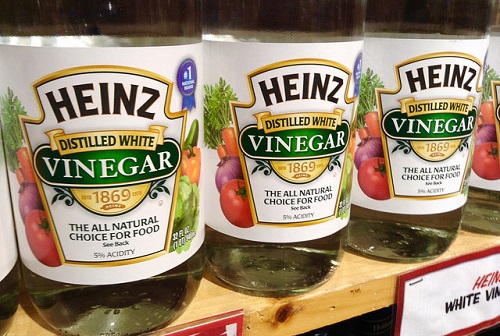
White vs. Distilled Vinegar
Try to look for vinegar at a local market and you will be surprised by just how many kinds you find. There is a staggering 21 kinds of vinegar available commercially. This number does not include the countless homemade types. But out of this vast range, distilled vinegar and white vinegar prove to be 2 of the most widely used. Sure, they’re both acidic, but in what ways do they differ from one another?
Most people agree that the basic difference is the level of purity. Simply put, distilled vinegar has been purified more than white vinegar. Furthermore, there are some dissimilarities when it comes to chemical structure, production, and usage.
White vinegar is sometimes also referred to as spirit vinegar. Contrary to its name, white vinegar is actually clear. It is usually produced from sugar cane, the extract of which is put through acid fermentation. In the process, the liquid is oxidized, causing the chemicals in it to change and become more acidic. Another way of making white vinegar is to combine acetic acid with water. This variation is much sourer than the naturally fermented type; it has 5% to 20% acetic acid content and is considered stronger than any of the other types.
Distilled vinegar, also known as virgin vinegar, can be made from just about any vinegar – for instance: rice, malt, wine, fruit, balsamic, apple cider, kiwifruit, rice, coconut, palm, cane, raisin, date, beer, honey, kombucha, and much more. As its name suggests, this vinegar is distilled from ethanol. ‘Distilled’ plainly means that the liquid component is separated from the base mixture. This produces a colorless solution with 5-8% acetic acid in the water – relatively weaker than white or spirit vinegar.
Both white and distilled vinegar are used not only for cooking, but also for cleaning, baking, meat preservation, pickling, and sometimes even for laboratory and medicinal purposes.
Since white or spirit vinegar contains a higher percentage of acidic content, it is more ideal as a household cleaning agent. It provides an eco-friendly solution for eliminating dirt and foul odor on a wide range of materials such as fabric, metal, glass, fur, tiles, and many others. It can also be used as a urine-cleaner for pets, as well as a natural herbicide or weed killer. White vinegar does not contain ammonia; it cleanses thoroughly without leaving any strong or harmful smells.
Distilled vinegar, being the milder variation, is more suitable for cooking, flavoring, food preservation, or as a food additive. Additionally, it can be used as a household remedy. For instance, it is an effective way of curing or preventing athlete’s foot and warts. It is also very helpful in relieving sunburn and prevents the skin from peeling or blistering.
Both white and distilled vinegar are widely available. Some people produce their own vinegar by fermenting fruit juices, slightly akin to the production process of wine.
Summary
- White and distilled are types of vinegar. They differ fundamentally in their acetic acid content.
- White vinegar, also known as spirit vinegar, has 5-20% acetic acid. This is generally higher as compared to distilled vinegar’s 5-8%.
- White vinegar is made through the natural fermentation of sugar cane extract or by combining acetic acid with water. Distilled vinegar can be made from any type of vinegar by separating ethanol from the base mixture.
Both distilled and white vinegar can be used in cooking, cleaning, food preservation, and for medical and laboratory purposes. However, since white vinegar is stronger than its counterpart, it is more suitable for cleaning and disinfecting. Distilled vinegar, on the other hand, is better for cooking, flavoring, food preservation, and as a natural home remedy.
Here are some of your questions
Is distilled malt vinegar the same as white vinegar?
Malt vinegar and white vinegar are not the same. While malt vinegar is made from ale or beer, white vinegar is made through the fermentation of neutral spirits, often referred to as plain ethyl alcohol.
What is white vinegar? Can you eat white vinegar? Is white vinegar edible?
–Yes, you can eat white vinegar. This is because it only has 5% acetic acid which is similar to the amount used in vinegar used for cooking.
Is distilled vinegar the same as white vinegar for cleaning?
– Distilled vinegar and white vinegar are not the same. Distilled vinegar contains less acetic acid than white vinegar, making white vinegar a less effective cleaning agent.
- Differences Between Fraternity And Sorority - January 8, 2014
- Differences Between Lucite and Plastic - January 7, 2014
- Differences Between Oil and Butter - January 6, 2014
Search DifferenceBetween.net :
 Email This Post
: If you like this article or our site. Please spread the word. Share it with your friends/family.
Email This Post
: If you like this article or our site. Please spread the word. Share it with your friends/family.
42 Comments
Leave a Response
References :
[0]https://www.flickr.com/photos/jeepersmedia/15893101667


Thank you very much for providing an education on the various uses of vinegar. And I have no doubt there are perhaps many more.
In my case a shot glass of white vinegar and a shot glass of Dawn liquid soap plus a thimble full of regular isopropil alcohol into a small bucket and “voila” no streaking even in the sun. Obviously YOU figure out the amounts you’ll need according to how many windows you are cleaning.
My best tip is use crumbled newspapers for drying rather than a squeegee or rags. Newspapers work SUPERBLY – just don’t use the comic strips.
Hey, smart guy, if ‘white’ vinegar and ‘distilled’ vinegar are two distinctly different things, then what is ‘distilled white vinegar’? My point is distilled vinegar is not white (it is as clear as water) and should be labeled ‘distilled vinegar’, NOT ‘distilled WHITE vinegar’. Case closed. Drop the ‘white’. It is not accurate or correct.
D
Maybe it’s white vinegar that has been distilled? Hmm..
@D Learned …Seriously? I dunno if I should insult your stupidity, your attitude, or your IRONIC name. Just STFU, your ignorance is a 3-day cringefest.
There seems to be an error in the last line that contradicts what is stated in the article. I believe it should say “distilled vinegar (not white) is less effective as a cleaning agent.”
Its not being used as a physical discriptor, only a differentiation.
Yep ( you’re smart, I do the very same
when mixing vin and dawn do u use water in the bucket?
Plz forgive me for not having replied in good time. Somehow I got sidetracked on my end. No you do not use water because water does nothing. What I’ve outlined is just fine. You can pick up a lot of added tips if you buy Heinz all natural distilled white vinegar. Call them @1-800-255-5750 for not only their booklet of tons of “uses” but also dozens of other incredibly great tips on all types of uses of white vinegar. It’s not only for salads/cooking — that will surprise you. I also use it as a TOP cheap water softener. It unclogs wash machine residues (1/2 cup on a rinse cycle) I buy white vinegar by the gallon cuz of so many household uses that it has. Keep in kitchen, laundry room, garage, unclog your steam iron with 2 runs, etc………Good Luck and enjoy.
Thanks for the phone number. I had something similar thumbtacked in one of my kitchen cupboards back in the 1970s. Darned angry that I forgot to take it with me when I moved. This sounds very similar to what I had (and have greatly missed). I will be calling them in the morning.
Thank you.
Can the white / spirit vinegar also be used for home remedies ie athletes foot? Thanks so much for a great article!
has been suggested to use apple cider vinegar as a rinse for getting yellow out of white hair would white vinegar work better since it has no color. Any other suggestions from anyone
I would say better stick with Apple Cider Vinger, as it’s more nutritious and not so irritating for your hair. It’s great as a hair conditionner rince just before getting out of the shower 🙂
Yes use purple shampoo and conditioner, (brass remover type) it actually looks purple in your hand. It netralizes brassy or yellow tones on blonde or white hair. You can buy some at the regular stores or Ulta beauty also. John Frieda makes one amount many other brands. You can also try Clairol shimmer lights sold at Sally’s beauty supply and you can also rinse with this really liquidy purple toner also but I recommend the shampoo and conditioner sets first cause it’s easier and I would leave them in maybe 3-5 mins each to give time to work. Also be careful how often you use these cause can turn the hair purple. I would maybe try once or twice a week or every other week or so. Hope this helps.
Which vinegar is better for cleaning fruits and veggies? The gallon (cheaper) size says “reduced with water to 5% acidity. Would that be effective enough for cleaning fruits and veggies
Hi, I need to buy white vinegar to make a buttermilk substitute, to do this I have to add a tbsp white vinegar to a cup then top the remainder of the cup up with milk and mix, then let sit for 5 mins..
The closest I can find anywhere is distilled white vinegar, is this the same as white vinegar?? I’m confused…
This is the vinegar I mean:
http://www.sainsburys.co.uk/shop/gb/groceries/vinegar/sarsons-distilled-white-vinegar-568ml
I carnt find anything else except for distilled malt vinegar…
Which vinegar is best for a sauerkraut salad?
In the first sentence, it should be ‘surprised by’ rather than ‘surprise of’. Poor sentence construct. Furthermore, I can accept ‘spirit’ vinegar, but there is no such thing as ‘distilled white vinegar’! It is simply ‘distilled vinegar’. It’s clearly clear. Milk is white. So there.
You are fabulous!
Dennis
Heinz has a gallon size of “All Natural” Distilled White Vinegar @ 5% acidity.
Dennis
I noticed Wegmans also sells “White Distilled Vinegar” and the ingredients listed on the side panel state it is made from white distilled vinegar reduced with water to 5% acidity.
Question… Im making pepper jelly. I need two cups of either Cider Vinegar (which I prefer) or I could use White distilled… (Yes, it does day white) Anyhoo… I only have one cup apple cider and a bottle of white… can I use a cup of each?
Let me answer this way. When I made my chive blossom/garlic scape vinegar, I used distilled white vinegar for a batch, I used apple cider vinegar for a batch and then I used a half and half mixture of white distilled and half apple cider vinegars combined. They turned out with each vinegar being infused with the chive blossoms and garlic scape but I believe the apple cider vinegar has a stronger taste because of it being “apple” than plain distilled white. Hope this helps.
Your title is wrong! Distilled vinegar is clear (white) vinegar! The dark brown color vinegar is apple cider and not distilled. Those 2 should be your “versus.” Distilled vs. Apple Cider.
Distilled vinegar and apple cider vinegar are made the same way, but use different starting ingredients. This results in differences in flavor and…
Oh my days,. There is more than two types of vinegar.
1)There is distilled vinegar (sometimes called distilled white vinegar despite being clear usually used for cleaning),
2)There is white vinegar( again clear and usually used for cleaning) ,
3)White wine vinegar ( a pale colour and usually used on salads and food),
4)Apple cider vinegar (usually a yellowish colour NOT DARK BROWN is used in salads on food etc),
5)Red wine vinegar (darker colour not quite brown but reddish hue, used again food and salads)
6)then you have your malt vinegar ((a brown colour THIS IS YOUR DARK BROWN ONE and used mainly on food)(in the UK malt vinegar is the most popular and is commonly used in fish and chip shops)
There are probably many more but these are the ones I’ve used and have had experience of learning and using in different countries cultures and recipes over the years
jodie, you came the furthest ahead of the rest on the forum in explained the various names, however like everyone else you failed to provide numerical evidence in relation to ingredients and dilution levels to justify your naming process…. points for effort though!
Wow. Who knew people could get worked up over vinegar? I have a bottle in front of me, Dennis…it’s Heinz White Distilled Vinegar. And, this was exactly what I was looking for: White Vinegar vs. White Distilled Vinegar because I have a recipe that calls for White Vinegar but all I have is the White Distilled Vinegar. It seems I have what I need. Thanks!
Dennis. You need a life and maybe meditation . Manners would also help.
It seems Dennis you are a very rude man!! Not necessary. Article informative.
I just found a mosquito in my bedroom and frightened by getting bitten. Can’t be sure if I killed it but as soon as my light went out it came out looking for a meal ( me ) ! I went online and found what I had on hand was my distilled white vinegar.
Even though I have off mosquito spray I’d much rather use something natural ( and did I mention not stain my sheets ) ? It stunk to high heaven but I applied it to my face and body using paper towel. The most important area under my nose and where carbon dioxide is detected from super far away.
This kicked butt with PEELING HARD BOILED EGGS earlier. Not sure about this vinegar thing or if it will even work tonight but going to purchase vanilla extract tomorrow for these pests.
They spread disease and if my smelling like vanilla doesn’t work I’ll have to just use the dreaded off spray. Thanks for listening everyone sorry I rambled.
Dennis, I have to agree with Melinda and Ann. There is a saying that says “Attitude is Everything”. Another one is “Sometimes you can be Right and still be Wrong”.
Both of these can apply to your posts. Think about it.
What vinegar do you use when boiling eggs ?
Need sugarcane vinegar please call 918840549041
I have a sweet pickle relish recipe of my uncle’s, he states use strong vinegar,not distilled. I’ve never found non distilled. And distilled seems to work. Any comments?
is it me or does everyone seem to have their own idea of the differences between the various names of vineger…. anyhow, i just want to know how one distinguishes the difference between white vinegar, distilled vinegar and distilled white vinegar if there is any as from many articles online its the same thing content wise!
Although i agree there are many types of vinegar im getting the impression after too much time spent searching online that white, distilled and distilled white vinegar are just that, different names for the same thing….
please give % of dilution for clarity aswell, I would like to see one person on this forum back their points with numerical evidence rather than statements for clarity.
; j
Thank you & well done for providing such a clear explanation on the subject of white/clear vineger! You have clearly explained the different manufacturing processes and acidic/alcolic content of vinegar. Very helpful indeed! You have cleared up all the confusion!
Respect to you all over!
Yes people being rude ova Vinegar,pathetic,I googled what ws the difference of dark malt Vinegar & distilled malt Vinegar(clear) as that’s what I had in my cupboard! WOW I couldn’t believe all the comments of of CERTAIN people,that had to not just add a comment but If they can get Rude ova Vinegar,Must be rude to others ova Anything in life,& obviously THINKS they’re Correct This Person Needs Anger Management!! ( I tend to read the ingredient label)Lol.Jane
.
PS The Name just confirms This,I think,lolx.
Thanks for helpful information.
What ratio do you use wit bicarb to get smells out of shirts.
Sorry I am getting confused. At the end of your article it states “ – Distilled vinegar and white vinegar are not the same. Distilled vinegar contains less acetic acid than white vinegar, making white vinegar a less effective cleaning agent.” I thought at the beginning, it explained white vinegar is better for cleaning as it has 5-20%