
 Values vs Beliefs
Knowing the difference between your beliefs and values can be a little confusing. People use both to guide their actions and behavior and to form their attitudes towards different things, but they are essentially different.
Beliefs are the convictions that we generally hold to be true, usually without actual proof or evidence. They are often, but not always connected to religion. Religious beliefs could include a belief that God created the earth in seven days, or that Jesus was the son of God. Religions other than Christianity also have their own set of beliefs. Non religious beliefs could include: that all people are created equal, which would guide us to treat everyone regardless of sex, race, religion, age, education, status etc with equal respect. Conversely someone might believe that all people are not created equal, which results in racist and sexist values and attitudes.
Beliefs are basically assumptions that we make about the world and our values stem from those beliefs. Our values are things that we deem important and can include concepts like ‘“ equality, honesty, education, effort, perseverance, loyalty, faithfulness, conservation of the environment and many, many other concepts.
Our beliefs grow from what we see, hear, experience, read and think about. From these things we develop an opinion that we hold to be true and unmovable at that time. From our beliefs we derive our values, which can either be correct or incorrect when compared with evidence, but nonetheless hold true for us.
It is possible for our beliefs and values to differ over time as we encounter evidence or have experiences that challenge our previously held views. Conversely our beliefs and values can also be strengthened by experience or evidence. For example, someone who believes in God might have that belief confirmed when they see a loved one recover from cancer and see it as a miracle delivered from God. However, a person might have their belief in the essential goodness of human beings shaken and changed if they have a truly terrible experience.
Everyone has an internalized system of beliefs and values that they have developed throughout their lives. These may stem from religion or may develop separately to religion.
Summary
1.Beliefs are concepts that we hold to be true.
2.Beliefs may come religion, but not always
3.Values are ideas that we hold to be important.
4.Values govern the way we behave, communicate and interact with others
5.Beliefs and values determine our attitudes and opinions.
- Difference Between Governor and Senator - November 14, 2009
- Difference Between Immigration and Migration - November 14, 2009
- Difference Between Who and Whom - November 13, 2009
I think you are missing something by focusing only on “big” beliefs like religion or politics. These beliefs are likely to be enduring, and only change quickly in response to some exceptional event. A bit like how a river gradually erodes one bank to shift course over thousands of years, but might one day burst its banks and find a new course, in response to a dam breaking upstream.
However, we also have countless small beliefs, like “I believe there is milk in the fridge”. These kinds of beliefs change all the time in response to sensory data, or even introspection (when we realise that two beliefs are mutually exclusive for example). In epistemology, belief is a component of Knowledge; the other components being Truth and Warrant (ie I have a good reason to belief it is True).
I think the phrase “usually without actual proof or evidence” is unhelpful here. Something like “within the limits of our ability to perceive the world directly” would help contextualise beliefs while sidestepping the whole philosophical debate about induction. Some beliefs have firmer foundations than others but all beliefs are limited by our inability to interact with the universe except through our (unreliable) senses.
Reply
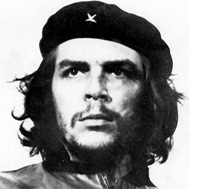
I just have a question. Who is that picture of at the top of the article?
Reply
It’s Jeebus.
Reply
The image is Che Guevara (http://en.wikipedia.org/wiki/Che_Guevara).
With regard to “big” beliefs vs “little” beliefs. What are beliefs? Can one “believe there is milk in the fridge”? To have in one’s mind the idea that if he/she opened the door to the refrigerator he/she would find milk — if the statement “believe there is milk in the fridge” intends that to be that idea — then the belief is not about milk, but an assurance that one trusts one’s memory of and reliance upon the circumstances that may have led to the milk being in the fridge, and that one would actually find the milk once the door is opened. So, “believe there is milk in the fridge” is not a small belief, it is a thought formulated on the idea of beliefs (“big beliefs) articulated in the original article; “big” beliefs such as trust (trust in one’s own memory about how the milk got into the fridge; trust that no one took milk from the fridge without keeping you informed of such, trust coupled with reasoning based on evidence that no one broke into your house and took the milk from the fridge, etc) so THINKING — perhaps more accurately, REASONING — that there is milk in the fridge is not a belief, but a conclusion based on beliefs and reasoning. In my view, a more useful construct for understanding behavior emanates from one in which beliefs are only the “big” beliefs — as you’ve characterized them — and from which beliefs (those “big” beliefs, basal foundations of accepted (vs proven) truths) lead to values (priorities — wherein we care about something more than something else), which when coupled with reasoning lead to behavior/choices of action/speech/decision/etc.
Reply
Today I had a man from Pakistan tell me that in their country they have values, I said sir we have values too then the other Pakistian man said that I need to understand and accept that they have more values then we do. I’m Spanish and the other person in the room was Black I felt degraded. What should i have said?
Reply
I would have told him that i am pleased that he holds so dearly to his cultures values, but he should understand that every culture has their own values. Some cultures even have some of the same. But it is not his place to judge others’ cultures if he has never really took the time to learn and understand them. Also putting a number per se on ‘how many’ one has is just a bit boastful and considered sin in some cultures
Reply
@Jennifer: We all have values, none more than the other. We have our priorities and he has his. I am young black South African, you are Spanish and he is Pakistani, what standards is he using to measure how much more values he has than the rest of us? Is he counting the numbers, the weight or the size?
What he places at the top of his value list, the value he values more, may not necessarily be the same for you and I, but we do have our number ones which we also equally value. I think he was just being stereotype and looking down upon other nationalities, which is not acceptable in this day and age.
Reply
Mr.p
Reply
thanks
Reply
Dear DifferenceBetween:
I request permission to include a PDF copy of several “Difference Between” web pages into a password-protected doctoral level course on ethical dilemmas and link to it from a study work page. The links to the live web sites will remain active in the PDF copies.
http://www.differencebetween.net/business/difference-between-ethics-and-morals/
http://www.differencebetween.net/miscellaneous/politics/difference-between-law-and-ethics/
http://www.differencebetween.net/language/difference-between-values-and-beliefs/
Thank you
Elaine Huber
Reply
We grant permission to use the requested 3 pages within the scope of fair use provided appropriate credit(a link to the page) is given.
Sincerely,
Nathan
Reply
Dear Admin,
I humbly request your kind permission to use the pages on the ‘differences’ between:
1. law and ethics;
2. ethics and values; and
3. values and beliefs
4. ethics and morals
for my first year law degree course lecture notes on ‘law and ethics’. The source will be acknowledged.
Kind regards,
Atangcho
Reply
While reading all above communication I like to share what in understood is.
What we Value is because we believe in them. And and inside the belief we have values. That’s what I understood. Your views please.
Reply
1.Are good value actual fixed in some people
2. Are the values independence of people, places, and time
3. Why do you think so
Reply
As humankind, we are governed by a number of values and beliefs and depending on your culture, race, and part of the world you grew up in someone else view of life will always differ even in the same culture, race, and religion. Our perception gives us different points of view even after learning the same information because we are individuals. Intellectually are mind collects information and apply it to what we feel deemed as truth. It will differ every time we will never be in full agreeance and do the same things unless somehow we are oppressed by the information that dictates our thinking. Choice, is always prevalent this makes us different than animals; which have an innate set of instructions to live and we must learn ours from parents or nurturer for instruction. So to sum it up who can really give judge of what values and beliefs truly mean without inflicting they opinion based on what they have perceived in life? We have become a people that want to know but have no idea what to know…ponder on that.
Reply