
Difference Between Corn Meal and Corn Flour
 Corn Meal Vs Corn Flour
The concrete definitions of a corn meal and corn flour have very little disparities making it almost indistinguishable from each other. Nevertheless, their definitions often elicit confusions to the public with regard to their location.
It may be somewhat confusing but the term corn meal may mean corn flour especially in many parts in the U.S. Derived from corn, corn meal can be turned into 3 preparations which include: the coarse ground corn meal, the medium ground and the fine ground corn meal. The medium ground corn meal is the one that is widely made available commercially. But corn meal will eventually be regarded as corn flour if it will be made into the much finer ground. Thus, corn flour is usually a finer ground compared to the original corn meal.
Specifically in the U.K., the term corn flour on the other hand can mean cornstarch, just as what most of the English people may have come to know. But many areas around the world recognize corn flour as totally different from cornstarch. In this regard, the non-English consumers of corn conceptualize corn flour as the actual flour that was made out of corn because cornstarch is just a sub component from the corn flour.
The corn flour often gives a strong aftertaste that is why it is not always advisable to be used as a thickener ingredient in making broth and some variations of soups. This taste is so strong that it may destroy the overall flavor or taste of the soup preparation. Unless you really want to taste the strong sweetness of corn then you must not use this ingredient.
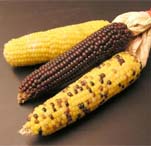
Depending on the corn type utilized, the corn meal can have any of three distinct colors that include white, yellow and even blue. The first corn meal color yield is popular in Africa, the yellow variation is a fad in some parts across the U.S. The latter can be made from the rare type of blue corn or perhaps a certain food coloring was added.
Lastly, after cooking the corn meal, it is usually used as a staple food in corn-rich countries whereas corn flour is usually used as an ingredient of a dish and not a ready-to-eat food in itself.
Summary :
1.Corn flour is a finer ground compared to corn meal.
2.Corn flour is not always recommended for use in soup preparations because it is the one that gives a very strong taste.
3.Corn flour is not readily a food in itself while corn meal is the staple food in some countries in the world.
- Difference Between Plant Protein and Animal Protein - March 7, 2024
- Difference Between Crohn’s and Colitis - March 7, 2024
- Difference Between Expression and Equation - March 7, 2024
Search DifferenceBetween.net :
 Email This Post
: If you like this article or our site. Please spread the word. Share it with your friends/family.
Email This Post
: If you like this article or our site. Please spread the word. Share it with your friends/family.


The difference between corn flour, corn meal, and corn starch is much simpler than described in this article. The best way to understand the differences is to understand the structure of the corn kernel. An analogy I use is that there are 3 main parts to the corn kernel, the germ or embryo, the pericarp and the endosperm. The pericarp is the outer layer of the corn kernel and acts like a grocery bag in that it protects the material inside. The pericarp reduces the rate of the water uptake. Now if we take this grocery bag and put into it a sponge filled with oil. This sponge is the germ, which is high in oil. Next we take a mixture of different size marbles and put them in the bag, filling the bag full. Now we take the bag with the oily sponge and filled with marbles and pour “Elmer’s” glue into the bag, letting it fill in all the void spaces in the kernel. The glue is protein, the marbles are granules of starch and the whole mixture of marbles and glue is called the endosperm. The marbles are encased in a protein matrix. That is the corn kernel.
Now lets use this analogy to understand corn meal , corn flour and corn starch. If we take the corn kernel and add a little bit of water to it such that it is preferentially absorbed by the germ and pericarp. The corn is then held for 15-30 minutes before going into a machine called a degerminator. This “tempering” of the corn loosens the connection between the germ and the pericarp, the pericarp and the endosperm and the endosperm and the germ., In the degerminator the kennels are confronted with a shearing action which rolls the germ out and peels back the pericarp, keeping it from shattering into small pieces. The endosperm is broken up into a myriad of different size pieces of marbles and glue (starch and protein), which can be separated into an infinite number of size fractions, but they are generally classified as:
Corn flour: The endosperm fraction from dry corn milling which passes through a #60 US sieve (250 micron or less)
Corn meal: The endosperm fraction from dry corn milling which passes through a #20 US sieve (840 micron or less) and retained on a # 60 US sieve (250 micron)
Corn grits: The endosperm fraction from dry corn milling which passes through a #3.5 US sieve (5,660 micron or lesss) but is retained on a #20 US sieve(840 micron).
To get the corn starch we need to use the wet milling process where corn is soaked in sulfurous acid (sulfur dioxide and water) for 24-48 hours to partially dissolve the glue (protein) encapsulating the starch granules. By fine grinding and using density differences and screens, the kernel can be separated into a germ fraction, a protein fraction, a fiber fraction and starch. The starch is almost completely absent of protein (99.7% starch) whereas the meal and flour fractions are 6-10% protein.
Hope this clears up the differences.
Steven –
while yours was by far the BETTER (and more informative) answer, I think most people would agree that it was definitely not “simpler.” 🙂
The analogy made it easier to understand, and it was definitely more detailed than the article. 🙂
That was a very informative and detailed answer!! Just what I was looking for. Please post where everyone can see!