
Legalization vs. Decriminalization
The differences between legalization and decriminalization are something that often confuses students. After all, the prefix “de” makes it seem as though an act is no longer illegal, which could be misconstrued for being “legal.” However, in law terminologies, “illegal” is actually different from “criminal” and, therefore, would put a different take on the legalization versus decriminalization issue.
To put it simply, “legalization” is the process of making a particular action legal. For example, legalization of prostitution means that patrons no longer have to hide whenever they seek the services of a prostitute; the act becomes completely legal and is just as acceptable as the purchase of gum or candy in a retail store. All the punishment and consequences previously attributed to the act are no longer in effect.
On the other hand, “decriminalization” means that the criminal penalties attributed to an act are no longer in effect. Going back to the original example, decriminalization of prostitution means that individuals found committing the act would be exposed to lesser penalties, such as a fine or a special permit instead of jail time. In this case, if prostitution were decriminalized, individuals engaged in the business would need to have the government’s official approval in order to operate; otherwise, they would get fined if caught doing it. Some individuals are of the opinion that the decriminalization of an act reflects the changing social values of a society. For example, should prostitution be decriminalized, it will mean that more and more people are learning to accept the presence of the industry. A decriminalized act has the possibility of being legalized after some years.
In essence, you would still need to hide when committing a decriminalized act – unless, of course, a special permit was allowed and you had one. Basically, if prostitution was to be decriminalized and you got caught in the act of soliciting a prostitute, then the penalties afforded would be no more severe than a speeding ticket.
It usually takes careful consideration on the part of the lawmakers when deciding on whether an act should be legalized or decriminalized. These concerned individuals would look into the future impact of an action and determine whether or not legalization would provide sufficient advantages. As mentioned, decriminalization reflects the changing views of society about various issues. Usually, society finds that an act does not have any negative side effects (or is so insignificant that the justice system shouldn’t bother with it) and should not, therefore, continue to be considered criminal.
Some of the acts that are still being considered today with regards to their criminality include abortion, homosexuality, euthanasia, polygamy, prostitution, use of steroids in sports, and even breastfeeding in public. The view on these subjects actually varies from state to state and from country to country. In fact, some governments have legalized prostitution (Germany and the Netherlands), while others clearly define it as illegal (Philippines and most Muslim countries). However, some countries have separated the two acts in prostitution (selling and buying), wherein the person who solicits sexual services is committing a criminal act, while the prostitute is not.
Summary:
1.Legalization makes an act completely acceptable in the eyes of the law and, therefore, not subject to any penalties.
2.Decriminalization simply means that an act is no longer regarded as a criminal act but is still subject to minor penalties or fines, much like getting a speeding ticket.
3.Decriminalization is often considered a result of the changing views of society.
4.Some believe that decriminalization of an act can lead to its legalization.
5.Examples of acts that are being pondered with regards to their criminality are: prostitution, abortion, and the use of steroids in sports.
- Differences Between Fraternity And Sorority - January 8, 2014
- Differences Between Lucite and Plastic - January 7, 2014
- Differences Between Oil and Butter - January 6, 2014
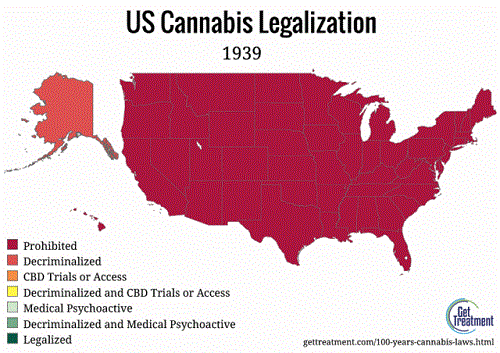
I came here because of talk of legalization / decriminalization of cannabis. Similar to how the article describes it, cannabis is usually considered for decriminalization, including store licenses, permits, medical requirements.
Considering that the “Journal of the AMA – Psychiatry” just ran an article concluding that the recent increase in legal cannabis usage (getting high) has not incurred an increase in any personality disorders, and there’s another news article every week about how cannabis reverses cancers and a host of other illnesses, it would seem to me that the different levels of governments should just legalize it.
One day, people convicted of aggressive driving will be ordered to have breath-a-lizers installed in their cars, and they will be required to smoke some pot before their cars can start and they’re allowed to drive on public roads.
Reply
This is incorrect regarding how the terms “legalization” and “decriminalisation” are used when referring to sex work.
For sex work “legalization” means that there are still criminal penalties, sex workers still face rules and regulations that impose criminal sanctions.
For sex work “decriminalisation” simply means the removal of criminal penalties for engaging in sex work. Under decrim sex work is treated like any other business and is simply regulated by usual workplace laws and workers do not face criminal penalties for engaging in sex work.
Under neither model does anyone have to “hide” the fact that they’re visiting a sex worker.
Source: I AM a sex worker of 7 years experience in Australia.
Reply
Decriminalization would benefit the worker so s/he could call authorities for help without fear of prosecution in the common event of rape and violence especially in street sex workers. Much rape and violence goes unreported because the perpetrators know how vulnerable they are and have no recourse.
Reply
Another crucial difference between decriminalization and legalization of opioids is that users and those addicted to heroin are obliged to obtain their daily fix from the black market where the drug they get is more than likely adulterated often with the more potent and lethal fentanyl which is responsible for over eighty percent of unintended overdose deaths in America.
Mere decriminalization of small amounts in one’s possession may avoid arrest or incarceration but that is if one survives the use of black market bought opioid.
The only way to protect American boys and girls from the black market would be to enable them to buy the drug they want from a pharmacy, where they would know what they are getting, pharmaceutical grade drug, best of all should be that no prescription is required.
You don’t need a script for other drugs which can kill you, e.g. aspirin, Tylenol, tobacco, alcohol to name a few.
The U.S. Constitution does not empower the government, the Congress, to dictate what you may possess, grow, plant, nurture, harvest, ingest, imbibe, inject or inhale and the Ninth Amendment refers to rights you retain which are not enumerated.
Reply