
Almost everybody must have done some basic DYI woodworking projects of his own at some point or still does every now and then. Whether it’s making a wood storage bin or an outdoor sitting bench or a wall planter for that matter, DIY wood making projects always seem to challenge and delight everyone, even for beginners. Everyone has that urge to build something out of wood, but simply lacks time and the required tools. Almost everybody loves woodworking projects, which is actually great if you wish to kill some time and it’s inspiring as well. Well, you don’t have to be a skilled woodworker to build something – all you need is a little push and the right kind of tools.
Choosing the right tools is the key to build your first DYI woodworking project and when it comes to tools, there are two that you probably need the most when working with woods – an axe and a hatchet. These are the most common percussion and cutting tools used for wood chopping and splitting. In fact, axes and hatchets have been used for woodworking for centuries and they still are. Both the tools are quite similar in appearance and they are often mistaken one for another, mostly by beginners. However, they are very different tools that do best what they are designed to do. So the question is which one you should choose – an axe or a hatchet? Let’s take a good look at the two and understand the difference.
What is an Axe?
An axe is an ordinary woodman’s most valued weapon – it’s a common woodworking tool used for chopping and splitting wood. It’s a heavy duty tool with a steel blade or heavy iron and a wooden handle. The heavy metal blade is sharp at one edge and attached by the other to the end of a long wooden handle. Both the sides are equally rounded off with no flat bevel on either. It is so designed to allow the workman to cut into the wood swiftly at any angle he may desire and the rounded faces are to prevent him from obtaining accurate flatness. An axe is ideally used with two hands for lots of purposes such as splitting firewood, shaping wood logs, cleaving, hewing, etc.
What is a Hatchet?
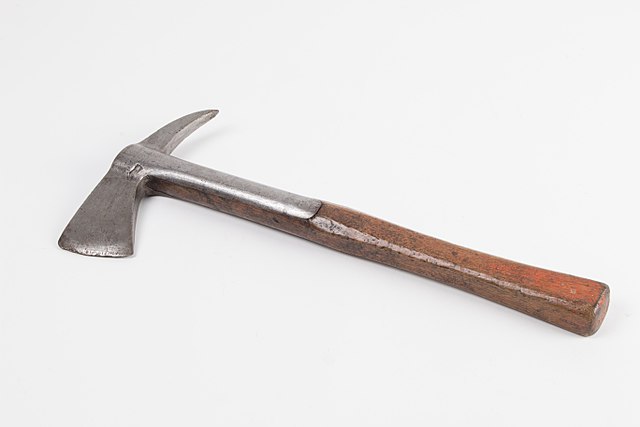
Hatchets in several forms are one of the most essential items in every carpenter’s or woodman’s tool chest. It is a tool quite similar to an axe but used for much lighter wood works such as cutting saplings, chopping wood, and so on. Unlike an axe, it’s a one-handed striking tool, like a small axe, with a sharp blade on one side and the hammer head on the other. A regular hatchet weighs around two pounds and is no more than a miniature version of an axe with a short handle. A lighter version of the hatchet, called the shingling hatchet, is also used by carpenters for shingling. Hatchets come in handy for splitting, trimming, nailing, and tearing off old wooden shingles. Also, other specialized forms of hatchets are used for different purposes.

Difference Between Axe and Hatchet
Basics of Axe and Hatchet
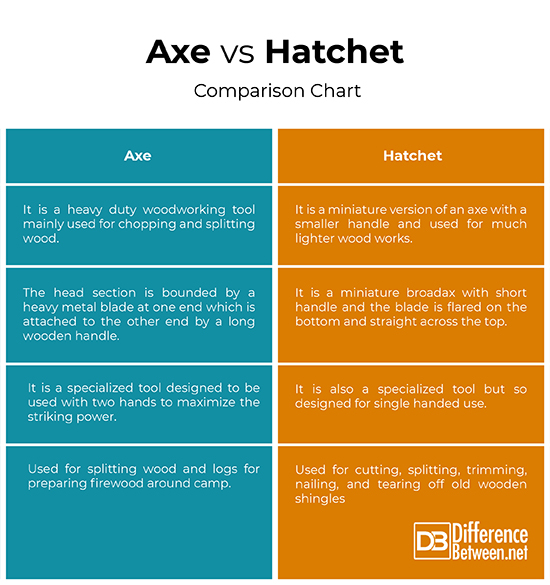
Although both axe and hatchet are common percussion and wood cutting tools as they combine the geometry of the hammer and chisel, they are very different woodworking tools that are designed for different purposes. An axe is heavy duty woodworking tool mainly used for chopping and splitting wood. It is ideally used with two hands and has long handles and may be swung as sledge hammers. Hatchets, on the other hand, are the miniature versions of an axe, quite similar to an axe, but with a smaller handle and are ideally used with one hand. Hatchets are much lighter in weight and used for lighter wood works.
Component of Axe and Hatchet
An axe has two primary components: the heavy metal blade is the head and the wooden handle. The head section is bounded by a heavy metal blade at one end which is attached to the other end by a long wooden handle. Both the sides are equally rounded off with no flat bevel on either. The head has blade on one side and the butt on the other. A hatchet is a single-handed tool with a short straight shaft and no bevel is put on the edge. The handle of a hatchet can be of wood, steel or fiberglass depending on use.
Intended Use for Axe and Hatchet
An axe is a specialized woodman’s tool so designed to be used with two hands to maximize the striking power, especially for splitting wood and logs for preparing firewood around camp. Survival axe is a great camping tool which provides firewood, shelter, and protection during camping. Battle axes are specialized form of axes with a single head and specially designed for combat. They are designed as both single and double handed axes. Hatchets are ideally used for single handed use especially for cutting, splitting, trimming, nailing, and tearing off old wooden shingles. However, a hatchet can be used for more than just making kindling.
Axe vs. Hatchet: Comparison Chart
Summary of Axe and Hatchet
Both the tools are quite similar in appearance and they are often mistaken one for another, but they are very different with each being uniquely capable of things that they are so deigned to handle. A hatchet is a miniature version of an axe, inspired by an axe, capable enough to be used for more than splitting and trimming shingles. An axe is to be used with two hands to maximize the striking power of the holder, whereas with a hatchet, you only need one hand which makes it uniquely different. Unlike an axe, hatches come with shorter handles and designed to handle lighter wood works such as trimming, splitting, and cutting shingles for preparing firewood around camp.
- Difference Between Pokémon Pearl and Diamond - February 16, 2026
- Difference Between Caucus and Primary - June 18, 2024
- Difference Between PPO and POS - May 30, 2024
As an old scoutmaster, I respectfully disagree. You need another category, first of all. You need to compare a “hand ax” to a “hatchet.” Comparing 3/4 and full axes to a hatchet is comparing tools from different size classes. “Hand ax” should be compared to “hatchet,” and distinguished by their differing features. In the absence of one, the other can be substituted but is generally the wrong tool.
I think over the decades, with a variety of new designs introduced from numerous regions of the world, the terms have become confused.
A hand ax, like larger axes, has a “bellied” handle for greater control — unlike hatchets, which typically have straight handles. A wooden hand ax handle has a broad shoulder and “poll” at one end and its knob at the other, both wider than the rest of the handle (though cheap axes that integrate metal handle with metal head most often do not have a broadened shoulder).
The hand ax head is typically broader than an ax, which tapers much more from bit to handle.
There are a variety of hatchets. The most familiar is the one used by roofers for use splitting. Roofing hatchets often have a hammer head opposite the blade. The hammer head can be used to drive small nails.
Hand axes should never be used to drive anything metal, and really shouldn’t be used to drive wooden tent stakes (though it’s so tempting to do). That’s because a hand ax head is often softer metal than a hammer. Using a hand ax to hammer metal stakes or nails not only mars the ax head but can send red-hot pieces of metal flying. One of our assistant scoutmasters has a bit of ax head metal that did just that beneath the skin on his neck.
Hand axes and hatchets are two different tools, whose designs were meant for different applications.
Reply