
Difference Between Apes and Monkeys
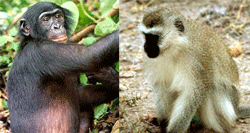 Apes vs Monkeys
Monkeys and apes are the animals being used for studies and researches very commonly. While there are some similarities in both the animals, the differences are many. The similarities being that both monkeys and apes belong to the Primate family and some of them look alike also. They have some common behaviors in terms of habitat and food. But the animals differ in many aspects.
Monkeys are the smaller primates while apes are larger. More specifically a monkey is a cercopithecoid or platyrrhine primate while an ape belongs to the Hominoidea family of primates. Scientifically speaking, the Old World monkeys are more related to the apes than to the New World monkeys. The Mandrill monkey is thought to be an ape by many owing to its size, but is in fact an Old World monkey. As the monkey family consists of the old and new monkeys, the ape family consists of chimpanzees, orangutans, gorillas, and humans. Humans are said to have evolved from apes.
Out of the two animals, an ape is cleverer than a monkey. This is indicated in its behaviors and activities. They are capable of learning signs, languages, the use of tools, and even display the skills to solve problems. The apes have larger brains and bodies than the monkeys. The body of an ape has a broad back and arms longer than the legs, while monkeys have slender, long chests and have arms which are as the same length as the legs or shorter.
Another feature by which you can distinguish both is the tail. Monkeys have tails while apes do not. But there are exceptions as some monkey species like the baboons and drills do not have tails. Monkeys are more used to the life on trees and the tail serves as a fifth limb to them in the purpose. And apes live more comfortably on the ground, though they can climb and swing between trees like the monkeys.
Monkeys are very commonly distributed all over the world but apes are not. You will be able to find monkeys even in places where you live. They can live in harmony with humans. But apes are not that widely distributed and there are many endangered species of apes within the family.
Some other physical features to distinguish between a monkey and ape are the nose and feet. The nasal openings of monkeys are slanted while those of apes are rounded. The feet of monkeys are webbed while apes do not have webbed feet. Another remarkable feature in apes is the opposable thumbs like the humans. Monkeys do not have this kind of thumbs.
Summary:
1.The apes are more close to humans than monkeys. Physically, the features like the slanting nose, webbed feet, body size, and tails make the monkeys different from the apes.
2.If apes are intelligent and are capable of displaying intelligence, monkeys shows no intelligence in its behaviors and are often considered as a nuisance to normal human lives as it destroys crops and plantations and disturbs people.
3.The nasal openings of monkeys are slanted while those of apes are rounded.
4.The feet of monkeys are webbed while apes do not have webbed feet.
5.Another remarkable feature in apes is the opposable thumbs like the humans. Monkeys do not have this kind of thumbs.
- Difference Between Schizophrenia and Psychosis - March 7, 2024
- Difference Between African and Asian Elephants - March 7, 2024
- Difference Between Sunscreen and Sunblock - February 15, 2024
Search DifferenceBetween.net :
 Email This Post
: If you like this article or our site. Please spread the word. Share it with your friends/family.
Email This Post
: If you like this article or our site. Please spread the word. Share it with your friends/family.


Siamangs, which are in the hylobatidae (gibbon) family and are considered to be apes. This primate is referred to as a lesser ape, but falls under the same primate group (hominoidea) as humans, gorillas, orangutans and chimpanzees. However, siamang’s 2nd and 3rd digits (toes) are webbed together. And not all monkeys have webbed hands or feet. Also apes are as destructive as monkeys and since they are larger can cause more damage, and even though they are smarter does not mean they are more considerate for humans. Also, monkeys may not be as intelligent as apes but that does not mean they display “no intelligence”. Capuchins, for example, are extremely smart and have been seen countless times using tools and even rubbing themselves with insect repellent leaves. There are a lot of monkey species that are extraordinarily smarter than a dog or cat. Most monkeys also have an opposable thumb; this is a distinction of primates, not apes. Apes on the other hand, have a better precision grip when using their thumb and index finger. Below I have listed some differences between apes and monkeys:
Compared to monkeys, apes have:
ï‚—more erect posture:
ï‚—Foramen magnum located more anteriorly
ï‚—Trunk held erect or obliquely in locomotion
ï‚—greater flexibility of shoulder and arm
ï‚—Longer arms and fingers (high intermembralindex)
ï‚—Shorter trunk (especially lumbar region)
ï‚—Less flexible spinal column
ï‚—Broader shoulder and thorax, with shoulder adapted to brachiation
ï‚—Long clavicle
ï‚—Scapula located dorsally
ï‚—Glenoidfossa oriented laterally
ï‚—Chest broad side-to-side
ï‚—Apes are tailless
ï‚—Ischialcallosities reduced or absent
ï‚—Have generally larger body size
ï‚—Have larger, more complex brains (Ca. 3 times as large as predicted)
ï‚—Enhanced cognitive abilities
ï‚—Molar teeth: low, rounded cusps, arranged in Y-5 pattern (not bilophodont, like monkeys)
ï‚—Lower anterior premolar more variable (sectorialto bicuspid)
ï‚—Canines more variable in shape and degree of sexual dimorphism
ï‚—Apes have large, robust hallux(big toe)
ï‚—Apes distinguished from monkeys by:
ï‚—Longer, slower life history
ï‚—Longer gestation
ï‚—Longer time to first reproduction
ï‚—Absence of female philopatry (Groups not organized around female matrilines)
ï‚—Fission-fusion foraging groups common
Bonobos are also apes.
i had copy and pasted this to get information for my monkey and ape project for english . it is about plagiarism and how not to do it. my english teach will make sure that we will not do plagiarism and only use the facts
isabel