
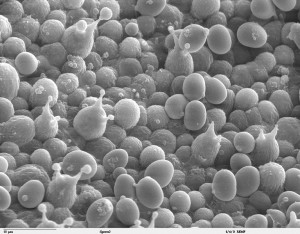
Scanning electron microscope image of budding mushroom spores. Agaricus bisporus
Seeds vs Spores
You’ve heard of seeds and spores before, and that they’re somehow connected to the plant kingdom, but not knowing one from the other won’t garner you a high grade in biology or botany. Differentiating between seeds and spores is highly important, especially if you’re going to classify plants. There are a lot of differences between the two, and understanding this can help you effectively distinguish a seed from a spore.
First off, a seed is much larger than a spore. Seeds can be seen and touched easily, while you’ll need a microscope in order to see spores. You definitely can’t scrutinize spores with your eyesight alone. You need a magnifying apparatus, such as a microscope, in order to check out spores. Aside from their tiny size, spores come in two types: heterosporous and homosporous. The former is further differentiated into a small male spore and a big female spore, while the latter comes in uniform sizes. Seeds also come in two types: a diploid, which has two, paired chromosome sets, or a haploid, which has only one paired chromosome set.
Second, a seed is more complex than a spore. Seeds are considered more advanced than spores, not only because of their size, but because of how they sustain plant life. In fact, the inner workings of a seed reveal a full-fledged multicellular environment capable of nurturing the plant and preparing it for the outside world. It has facilities for nourishment and defense, augmenting the plant’s survival chances. On the other hand, a spore is unicellular and simpler in structure but, like the seed, it is also able to survive in the outside world.
Third, seeds and spores differ when it comes to their location. Seeds can be found either in flowers or the fruits of flowering plants, while spores are located underneath the leaf area of fungi, ferns, and moss plants. Once they are released into the outside world, seeds can sprout just about anywhere. They’re not choosy about where they’ll germinate. On the other hand, a spore requires a wet environment, such as a marsh or a swamp, in order to germinate.
Fourth, seeds and spores may be transported to the outside world by different means. Seeds can be transported by animals who eat the fruit of flowering plants and either disseminate or disgorge the seeds within. Seeds can also simply fall off the plant and roll to the ground where they will germinate once they have been sufficiently nourished with enough water and sunlight. On the other hand, spores simply fall off of leaves and float slowly to the ground or are wafted upwards and spread further by air currents.
Even though seeds are more advanced than spores in more ways than one, both of them are necessary for the propagation of plant life and are effective ways by which plant species survive in the present world.
Summary:
1. In terms of size, seeds are larger than spores. Seeds can be seen and touched easily whereas spores can only be seen with the aid of magnifying equipment.
2. In terms of cellular complexity, seeds are superior because they’re multicellular, while spores are unicellular. A seed also has more facilities for plant survival than a spore.
3. Seeds are located either in the fruit or flower of flowering plants, while spores are located underneath the leaves of non-flowering plants. When they are separated from the plant, both seeds and spores eventually germinate. However, a seed germinates more easily than a spore because the latter requires a wet environment.
4. Seeds are disseminated by animals that eat the fruit of flowering plants, while spores simply fall off and may be spread by the wind.
- Difference Between Sunni and Salafi - October 24, 2010
- Difference Between Visa and Work Permit - August 1, 2010
- Difference Between Acrylic and Glass Bongs - August 1, 2010
This poorly researched article confused many of my introductory biology students into thinking that seed plants do not produce spores. All plants produce single-celled spores, and none of these organisms can be called “one celled,” as the author suggests. Further, it should be obvious to even those unfamiliar with plant biology that not all seeds are or need to be planted in the ground.
Finally, the passage that reads, “[p]lants that produce the seeds are known as higher level organisms whereas lower level organisms such as fungus, ferns, mosses ,bacteria and etc. are known to produce spores” shows a complete lack of knowledge of modern biology. There are no such things as “higher level” or “lower level” organisms.
It is a shame to see that this article ranks so high on Google’s search. I recommend it be either completely rewritten or removed.
Sincerely,
Brad Duthie
PhD Candidate
Iowa State University
Reply
This web page is full of inaccuracies. I teach college classes to impressionable incoming freshmen who are still learning to distinguish reliable web sources. If you intend to provide such information please either cite where you got your information or start with “We think …” so that students can read it skeptically.
Thank you for your time.
Melissa Telemeco
Graduate Student
Iowa State University
Reply
You know, I’ve read these comments and they’re all formal and whatnot but they are even less helpful then the article itself I’m just a sophomore in high school and here’s how I see it: Not only are you saying how “bad” this article is but your also not doing anything about it, heard of the saying “If you want something done right do it yourself”? YEAH so do it, don’t just sound all smug about yourself for writing some formal paragraph because you’re a Professor at a college DO SOMETHING ABOUT IT….~ If this is what all professors act like then there is NO WAY I’m going to college! I have to write a paper on this topic and I would feel HONORED to gain information from a University but you don’t seem willing too spend a little time and do something about it. Yeah, I know I’m talking big for my age but I’ll follow up this comment with a summary of my research and you can “formal comment” me back how bad it is, Then tell me my mistakes GOODBYE
Reply
If you are saying seeds aren’t choosy, they are. If you and try to plant corn in northern Wisconsin where the ground is sand, you won’t have corn because it’s too sandy. Pine trees are adapted to this soil and other soils and that’s why they are so numerous there. Certain plants in certain soils are like fish out of water.
Reply
Sorry I posted it and I wanted to add something and I couldnt
Reply
First off, seeds aren’t choosy because they can’t decide where they grow. The soil where they land makes an impact too. If you plant corn in sand, the corn will NOT grow well or at all. If you plant a pine or fir tree in sand, it will thrive. Coniferous trees are adapted to multiple soil types where as corn is not. That said, it shows you have little knowledge on seeds. Spores on the other hand are more likely to grow in swampland because they are adapted to that environment. Although they grow in lots of places they thrive in swampland.
Reply