
Differences Between a Nova and a Supernova
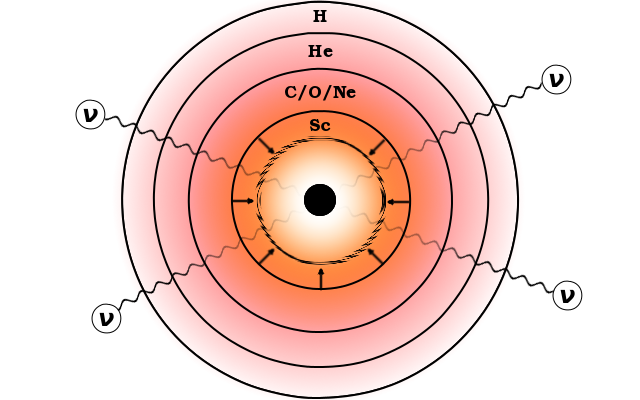
Super Nova Explosion
Nova vs Supernova
Nova and supernova are two features of the universe. A nova is defined as “A star that suddenly becomes much brighter and then gradually returns to its original brightness over a period of weeks to years” (1). On the other hand, a supernova is “a rare celestial phenomenon involving the explosion of most of the material in a star, resulting in an extremely bright, short-lived object that emits vast amounts of energy” (2). From the definitions it is clear that both nova and supernova result in tremendous amount of brightness.
The major difference between a nova and a supernova is that in a supernova a lot of the object’s mass is ejected with the explosion. The amount of this mass is more than the mass of the sun. Where as in a nova, very less mass is ejected as compared to that in a supernova.
A nova does not destroy its host star whereas a super nova does. Since so much mass is ejected in a supernova it disrupts the star in which it occurs. This results in another difference which is that a nova can be seen at the same place multiple times, on the other hand, a supernova cannot.
A nova is the result of “eruption of a very old dying star”(3); supernova is also the result of a dying star but it is the result of a “violent” explosion of the star (3). Meaning the amount of energy released in a supernova is much greater than that released in a nova; usually this value is about 1044 Joules (4).
Additionally, a supernova lasts longer than a nova. A nova is generally of a period between a few weeks to years.
Another thing that differs between the two is how often does each occur. Scientists usually detect a few novae each year; whereas super novae are detected roughly once every fifty years.
Nova usually occur in binary systems where the white dwarf absorbs matter from the other star and this results in large compression which makes the star ignite. This process occurs through nuclear fusion. (5) A supernova is usually formed after either a chemical imbalance, or due to implosion of the core of the host star.(6)
Supernovae are classified into two types: Type I and Type II. These types are classified on the basis of the chemical reactions that result in them. Novae, however, have not been classified into any such types.
Many times these two are taken to be the same thing; however there are significant differences between a nova and supernova. One of the most important is that supernovae are eject much more mass and energy as compared to novae.
Summary:
1. Supernova releases much more mass than a nova.
2. Supernova destroys its host star; whereas a nova does not.
3. Supernovae cannot occur at the same place more than once.
4. More energy is released in a supernova than in a nova.
5. Supernova lasts longer than a nova.
6. Novae occur more often than supernovae.
7. A nova usually occurs in binary star systems when a white dwarf absorbs a lot of matter; where as a supernova can be formed by either chemical imbalance or core implosion.
8. Supernovae have been classified into Type I and Type II. No such classification has been made for novae.
Works Cited
1. “Nova.” The Free Dictionary. Farlex, n.d. Web. 19 Feb. 2014..
2. “Supernova.” The Free Dictionary. Farlex, n.d. Web. 21 Feb. 2014..
3. Seeds, Michael A. Stars and Galaxies. Belmont, CA: Thomson Brooks/Cole, 2007. Print.
4. “Supernovae.” Supernovae. N.p., n.d. Web. 20 Feb. 2014..
5. Anissimov, Michael, and Bronwyn Harris. WiseGeek. Conjecture, 17 Feb. 2014. Web. 20 Feb. 2014..
http://commons.wikimedia.org/wiki/File:Super_Nova_Explosion_(Explosion)(Neutrino).png
- Difference between technology and engineering - February 25, 2014
- Difference between nebula and galaxy - February 24, 2014
- Difference between force and momentum - February 23, 2014
Search DifferenceBetween.net :
 Email This Post
: If you like this article or our site. Please spread the word. Share it with your friends/family.
Email This Post
: If you like this article or our site. Please spread the word. Share it with your friends/family.


This article is awful. There’s no other way to say it. Not only does it get most of the facts wrong, but it is written very poorly and is hard to understand. It’s best to just forget everything you just read above while I clear it up.
Nova means “New,” and refers to new stars that seem to appear in the night sky. Sometimes Novae are so bright they can even be seen during the day. Long ago, Novae and Supernovae were thought to be the same thing: new stars that appeared in the sky, but soon faded.
However, the two phenomena are very different in origin.
Stars are massive balls of hydrogen and helium gas with other trace elements thrown in. Stars form when massive clouds of gas and dust in space fall in on themselves because of gravity. Gravity is the result of mass–the more massive something is, the more gravity it exerts. As a collapsing cloud of gas and dust gains mass it pulls harder and harder on the gas and dust inside, creating a great amount of pressure. As the atoms of hydrogen and helium are forced closer and closer together under this pressure, the star heats up. This is called gravitational heating.
Eventually, if the ball of gas is massive enough, the heat and pressure in the center become so great that hydrogen atoms (one proton and one electron) in the core are jammed together to form helium atoms (two protons, two neutrons, two electrons). This is called nuclear fusion. Nuclear fusion gives off a tremendous amount of radiation, light, and heat, and is the reason stars do not simply cool down after a few million years–fusion replaces the heat lost into space.
Gravity pulls material in, and heat tries to force material back out. When the two forces are in balance, meaning the star stays the same size for a long, long time, the star is said to be in hydrostatic equilibrium. That’s just fancy way of saying the gravity pulling and the heat pushing are in balance. But it doesn’t stay that way forever; helium ‘ash’ is building up in the core of the star.
Eventually there is so much helium in the star’s core that the enormous pressure and temperature crams the helium atoms together to make even heavier elements, like carbon, nitrogen, and oxygen. When this happens the star goes through some changes because of the new, greater source of heat.
Now, depending on how massive the star is there are several ways this can go: Smaller stars just sort of peter out. Medium stars bloat up until they cool off a bit, then collapse again, then bloat, then collapse–it’s a cycle, and the star blows off gas into space forming a pretty cool-looking nebula that looks like an hourglass or a ring depending on what angle you see it from. When it is done blowing off these layers, the carbon and oxygen core that is left behind is called a White Dwarf.
Really big stars keep fusing heavier and heavier elements together until they reach iron. It takes too much energy for the heat and pressure in a star to fuse iron into anything heavier. This means that as the iron core of the star gets bigger and makes more iron, the iron chokes the fusion, causing the star to cool. This happens pretty fast, and when it does, the outer parts of the star suddenly are not being held up by heat anymore: The star is out of hydrostatic equilibrium. The star falls very fast into itself, gaining speed faster than the rising heat and pressure can control.
Then: All that stuff crashes together with the iron core. In moments the ridiculous pressure causes fusion of even heavier elements: gold, lead, silver, uranium, and all the other really heavy atoms. This rapid fusion takes the form of a massive explosion, and the star suddenly brightens to brighter than all the stars in the galaxy combined–and it blows up. BIG BOOM.
This is called a SUPERNOVA.
However, this isn’t the only way to get a supernova. There are a few other methods to blow stars up, but I’ll leave it up to your curiosity to look them up and find out about them. Wikipedia is a great source for further exploration.
After a supernova, there is what’s called a supernova remnant left behind. This is what’s left of the star. There are a couple different kinds of supernova remnant: neutron stars and black holes. What an exploding supernova leaves behind depends on how massive the star was in the first place.
Only the biggest stars leave behind black holes. Black holes are not ‘swirls of matter and energy’ nor do they ‘suck in light.’ The above article really fails on this subject; if you want to know more about what black holes really are, you should look elsewhere. Again, Wikipedia is full of great info.
The mass of a star also controls how fast a star will burn through its hydrogen. Small stars are much cooler than big stars. Small stars burn hydrogen much slower than big stars. The smallest stars can live for hundreds of billions of years, and eventually just fade away. The biggest stars might not even make it to a million years old before they go KaBoom.
Many stars out in space are part of multiple star systems, which means there are two or more stars orbiting around each other. Often these stars will be of different masses, one being more massive than the other. Because the stars are different masses, one will inevitably go and blow off its outer layers long before the other one, leaving behind a white dwarf.
Now when the other star starts to bloat up, or if the other star is very close to the white dwarf, the white dwarf will start pulling on the gas from the other star and stretching it into a flat disk around the white dwarf. This is called an accretion disk. Accretion is just a fancy word for ‘stuff sticking together.’
Accretion disk material, or hydrogen, falls onto the white dwarf, meaning the white dwarf is building up a layer of hydrogen on top of the exposed core. Eventually there is so much hydrogen that fusion starts again. When this happens, the sudden heat and light basically blows the hydrogen layer up, throwing it off the white dwarf in a bright flash.
This is called a Nova.
I hope this was easier to read and understand than the mess that the main article created. If you read the main article, I’m sorry. Please just forget it and use my explanation for a primer. Then go to Wikipedia or any of the hundreds of great astronomy sites out there. Thanks for reading, and thanks for being curious about astronomy!
Hey you…a Thank you!!!!❣
Thank you for your reply. I am not an astronomer. I started to search “explosions in the heavenlies” when I heard that after seeking God about what the Year 2017 would bring. Of course, He often reveals things in symbols that represent events that will manifest in the earth i.e The Book of The Revelation. So much more exploring to do. The makings of a supernova actually have symbolic interpretations in scripture.
Great explanation for the everyday Joe. The earlier explanation regarding chemical imbalances had me scratching my head. The original article was high school science project quality, at best. The revised article explained things in a format that is more accurate and easier to understand. Good Job!
typo oops: supernova total energy output may be 10^44 Joule
not 1044 joule
White dwaf blows off hydrogen layer nova. White dwarf explodes super nova 1a what is the difference
10 in the power 44 joule
Thank you for the great information!