
Difference Between Xenon and Bi-Xenon
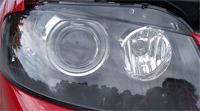 Xenon vs. Bi-Xenon
Headlights that use Xenon bulbs are quickly gaining popularity over the traditional halogen headlights, due to their brighter light, efficiency, and long lasting bulbs. Xenon and Bi-Xenon headlights do not have a fundamental difference, since they both use the same Xenon bulbs. They differ only in the number of bulbs that are in each set of headlights. Xenon headlights use two pairs of bulbs just like halogen headlights, while Bi-Xenon headlights use only a single pair of bulbs.
As we all know, cars set their headlights high to increase the distance of visibility, or low to avoid blinding oncoming traffic. Xenon headlights have fixed bulbs, with one pair aimed high, and another aimed low. Bi-Xenon headlights get away with using just two bulbs by employing a mechanical system to direct the beam of light. There are two common ways of achieving this. The first is by moving the bulb itself, so that it aims appropriately, or secondly, by using a fixed bulb with movable reflectors that achieve the same goal.
There are advantages to using Bi-Xenon headlights when compared to Xenon headlights. Since each Xenon headlight contains two bulbs, it has a higher probability of failing, compared to a Bi-Xenon headlight that only has one. This is because, if either of the two bulbs in the set fail, the whole assembly is rendered useless. Due to the fewer number of bulbs in the assembly, Bi-Xenon headlights are also expected to be cheaper compared to Xenon headlights that have twice the number of bulbs. These things make Bi-Xenon headlights a good choice for most car owners.
Despite being highly unlikely, Bi-Xenon headlights might suffer from mechanical failure caused by repeated transition from high to low, and vice versa. All mechanical systems suffer from wear and tear each time they are moved. Xenon headlights have no moving parts, and are therefore immune from this problem.
Summary:
1. Xenon and Bi-Xenon headlights are identical in terms of the bulbs that are used.
2. Xenon headlights use four bulbs, while Bi-Xenon headlights only use two.
3. Xenon headlights switch between two sets of bulbs for high and low beams, while Bi-Xenon uses a mechanical system to set the beam of light.
4. Bi-Xenon headlights are less likely to fail compared to Xenon headlights.
5. Bi-Xenon headlights can be cheaper than Xenon headlights.
6. Bi-Xenon headlights can suffer from mechanical failure, to which Xenon headlights are immune.
- Difference Between Sony Cybershot S Series and W Series - December 22, 2012
- Difference Between Samsung Galaxy S3 and iPhone 5 - December 21, 2012
- Difference Between Samsung Galaxy S2 (Galaxy S II) and Galaxy S 4G - December 20, 2012
Search DifferenceBetween.net :
 Email This Post
: If you like this article or our site. Please spread the word. Share it with your friends/family.
Email This Post
: If you like this article or our site. Please spread the word. Share it with your friends/family.


there is an error in your logic here.
there is no difference in failure rate, assuming all bulbs are identical. if one assumes a “set” to be directional (i.e. L/R), a failure of A bulb in the L/R assembly, in either xenon or bi-xenon case,would disable that entire L/R side; advantage: NEITHER
if one assumes a “set” to be Hi/Lo beams, a failure of a bulb in the xenon system will still leave either the Hi or the Lo beam working for forward visability. on the contrary, for bi-xenon, there will be no working lights left; advantage: xenon
Ok, let’s do this properly. If there are two bulbs, each with a probability of failure of 1% in a given period (say) then there’s a 98.01% (=99% squared) probability that neither of them will go.
If there are four bulbs, then there’s a 96.059601% (=99% to the power of four) probability that none of the four will go.
If your definition of failure is that any one of the bulbs goes, then the bi-xenon’s are clearly the right choice. If you’re happy to drive around on low-beam the whole time (making yourself tolerant to high beam bulb failures) then it gets closer, but then you find yourself crashing into deer on dark country nights, or at the very least attracting the attention of the local constables.
Bi-xenon sounds right to me.
A bulb’s failure rate depends mostly on how long it has been *in use*.
Let’s say the bulbs are rated at 100 hours of use, and you use 90% low beam and 10% high beam.
– If you have bi-xenons every 1000 hours of traveling you are going to change the bi-xenons 10 times.
– While with normal xenons you will change the low-beams 9 times and the high beam 1 time.
So the cost remains almost the same.
Since most bulbs fail with the sudden shock at power on, there’s a distinct advantage to a system that leaves one bulb on and moves it, over a system that alternates between 2 bulbs.
Advantage bi-xenon
Hi all,
I have 14yr old car with Xenon headlamps (Audi A3, 2004) with almost 240,000 kilometers and Xenons are still originals, very well litt after all this years 🙂