

You might have seen the words center and centre being used interchangeable, which is for good reason. For all intents and purposes, besides the two words being spelled differently, they are actually very similar, if not the exact same. Let’s figure out what both center and centre mean.

What is Center?
Center is a word that is used to indicate or describe the middle of something, such as the center of attention. The word center is used most often in American English, referring specially to its spelling.
What is Centre?
The word centre has the same meaning. It indicates the middle of an object or place in time, such as the middle of the afternoon or the middle of the soccer field. This spelling specifically is most often used in British and Canadian English.
Similarities Shared Between Center and Centre
As you might be able to tell, there are some similarities shared between these two words.
The Language
Both center and centre are a part of the English language.
Meaning
Both of these words, center and centre, have the same meaning, as they indicate the middle of a space or time.
Contextual Use
Because they both have the same meaning, both center and centre are used in the same contexts, such as to indicate the center of a place or time.
Function
Both of these words have the same function in the English language.
Differences Between Center and Centre
As you might be able to tell, there are some differences between these two words.
Spelling
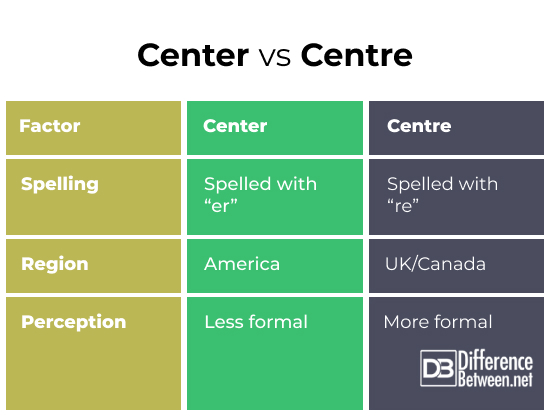
The biggest difference between these two words is their spelling, as one ends in er whereas the other ends in re.
Region
The only substantial difference between the two words is that center is the American spelling of the word, whereas centre is the British and Canadian spelling of the word.
Center vs Centre
FAQ
Is it center or Centre in Canada?
In Canada, the spelling centre is most commonly used.
How do you spell Centred in Canada?
In Canada, according to British English, it is spelled centred not centered, as it would be in American English.
Is there a difference between Centre and middle?
No, both centre and middle are used to indicate the center point or middle point of a specific object, space, or time.
Why are center and centre different?
The main difference lies in their spelling and regional applications, as one is the American spelling, and the other the British spelling.
Do Canadians use British or American English?
In school, Canadians are taught to spell in British English, although everyday life often involves instances of American English.
Conclusion
As you can see, the English language is quite the interesting one. Although center and centre are spelled differently, they have the same meaning. The only substantial difference between the two is where they are used.
- Difference Between IELTS and TOEFL - May 14, 2024
- Difference Between Tactics And Strategy - May 11, 2024
- Difference Between Zionism and Judaism - March 7, 2024
Thank you for a very clear article that helped clear out my misunderstanding of the difference between the words. (I had built a mental picture based on concrete or abstract thinking, but this article put me right.)
Reply
Actually braces are also orthodontic equipment here in the UK and using braces to hold up our pants (which we call trousers) is pretty well unheard of.
Reply
Indeed, I thought these are also referred to as ‘suspenders’?
Reply
“braces are orthodontic equipment in American and a device to keep your pants up in Britain.”
They’re orthodontic in Britain as well. Also, in Britain, you wouldn’t use braces to keep your pants up anyway, since they normally stay up by themselves and it would probably give you a bad wedgie if you attached braces to your underwear.
You might use braces to hold up Trousers, however.
Reply
I was taught that “center” is literal, as in the center of a circle or table. And, “centre” is abstract, as in health centre or centre for humanist action.
Reply
I must admit I Was taught along those lines too. Centre for a building or meeting place etc and center for the middle of something.
Reply
I was taught the same thing too. It’s a leisure centre whereas a circle has a center.
Reply
Hmm, this clarifies how I should advertise my cosmetic surgery center (centre) 🙂
Reply
Good post thank for providing useful information.
Reply
Yeah in UK english the word “Ass” means an animal, where in American ‘ingleesh’ Ass means ‘Butt'(Buttocks).
LMFAO! 😉
Reply
And don’t lets get started on the “fanny”!
A couple of things I noticed – wouldn’t the “center” normally snap the ball for the quarterback?
And the centre forward is actually a position in soccer (which is more widely known as football – apart from in the US and to devotees of other sports such as rugby or Aussie rules).
Reply
This is a brilliant. Good and logical simple layout, easily understood construct, excellent content. Very well done. 🙂
Reply
@Wm. Perry – I fail to see how a health centre is abstract. Is it not a concrete place one would visit for health issues?
Reply
A health center is not the literal mid-point of anything, like the center of a circle. We only call it “center” because it is an important place, a metaphorical focal point of the industry, which has no physical center. I was never taught this rule but it is how the word is commonly used in the midwest. I assume we do this because we only see British spelling in proper names, and therefore learned to associate it with a different sense of the word.
Reply
Thank for explaining in such a brief way well you clear my doubt thank one’s gain for the information
Reply
“British sports such as the centre and centre forward in rugby”…..
There is no centre forward in rugby ! I think you mean:
British sports such as the centre (rugby) and centre forward (football)
Reply
I will guarantee that had I spelled center, centre when I was learning “English”, in the 50’s & 60′ it would sure ass hell been wrong. And OBTW the automatic spellcheck red lined it and the answer was, you guessed it “center or Centre (no red lie) or canter ??? and you know the rest!
Reply
“. . . countries that have adopted the British system of spelling such as Canada and India.”
You mean countries that have continued to use English as it was introduced and as it should be used. People may “adopt” the American form of English; however, those using correct English are not adopting the British system . . . the British system is correct English that has not been simplified and dumbed down.
Although often said as a joke when people play with their iPhones and have to select American or British English, there is more than an element of truth in the line: American English? There is no such thing. There is English, and there are mistakes.
Reply
This is somewhat untrue. One must understand the history of English in order to comment on its modern state. In Middle-English, spelling was often varied and a ‘correct’ system did not exist. In some instances, many of the same words could have entirely different spellings depending on the dialect that a document was written in and the scribe (or monk) who wrote it. For example, words such as knight or life varied in spelling; furthermore, ℎ was often spelt as ȝ (or ℎ/ℎ, note that is wasn’t pronounced the same way either), and life had manifold spellings (, , , and many others). That is to say, these two instances are not the only occurrence of English spelling varying in nature. If was only after the Printing Press was invented that spelling started to shift into a more unified form, and even into the Enlightenment Era, spelling sometimes varied in nature. I’ve seen a few instances of books from the 18th-Century spell words in ways that we would consider to be complete errors today; here are a few examples of this that I can give: publick being spelt as ‘publick’, phenomena as ‘phænomena’, connection being spelt as ‘connexion’, and forty being spelt as ‘fourty’. In reality, neither system can be considered correct or incorrect since English spelling has always varied.
Reply
There were some source errors in my comment, as some words did not appear as intended (I attempted to Italicise some words, but they vanished when I posted the comment; therefore, I sadly won’t be able to do so). I was trying to say that the word knight was often spelt as knyȝt, knicht, knyht, cnyht, chiht, kniht, and many others. I was also trying to say that that the word life could also be spelt as lyf, lif, or lijf (or any other scribal or dialectal preference).
Reply
Now here is a conundrum! Despatches of the East India Company, and also by General Sir Arthur Wellesley from India spell the word CENTER! These can be seen at the British Library in London.
So sometime after that time the British and most of Europe adopted the CENTRE spelling whereas the more phonetic spelling was adopted by the residents of the USA.
Incidentally the spelling of Color – USA English comes from the Slavonic nations and is common in Germany.
USA English is often a phonetic spelling, and to state that the UK English is the correct spelling of a word is no more correct than to claim that the US spelling is. Both are correct for the simple reason that that is the common usage in the country concerned.
Reply
Everytime I saw the word centre here in the U.S I would pronounce it Sen-trey. I always thought it was a fancy way of saying center or naming your business with that spelling. Liter = Litre, Meter = Metre. Born and raised here in America and been indoctrinated and ethnocentric simultaneously I would always say why are things spelled different and why do Brits have an accent, at the time not knowing that Americans are the ones with the accent.
Reply
yes I read this paragraph fully about the resemblance of most up-to-date and earlier technologies, it’s amazing article.
Reply
thanks for sharing
Reply