
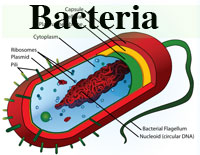
There are two kinds of microorganisms that are divided into prokaryotes and those include bacteria and archaea. But not all bacteria and archaea belong to prokaryotes. Complicated subject, isn’t it? Here is more information on the differences between these two microorganisms.
Both bacteria and archaea have different Ribosomal RNAs (rRNA). Archea have three RNA polymerases like eukaryotes, but bacteria have only one. Archaea have cell walls that lack peptidoglycan and have membranes that enclose lipids with hydrocarbons rather than fatty acids (not a bilayer). These lipids in the membranes of archaea are unique and contain ether linkages between the glycerol backbones rather than ester linkages. Archaea resembles eukaryotes more than bacteria. Their ribosomes work more like eukaryotic ribosomes than bacterial ribosomes.
These two microorganisms also differ in genetic and biochemical ways. Only within the last couple of decades, archaea were recognized as a distinct domain of life. They are extremophiles, meaning they thrive in physically or geochemically extreme conditions. They have similar ecological roles as bacteria. Both of these organisms react to various antibiotics in a different way.
Summary:
Archaea: cell membrane contains ether linkages; cell wall lacks peptidoglycan; genes and enzymes behave more like Eukaryotes; have three RNA polymerases like eukaryotes; and extremophiles
Bacteria: cell membrane contains ester bonds; cell wall made of peptidoglycan; have only one RNA polymerase; react to antibiotics in a different way than archea do.
- Difference between Hypothesis and Theory - August 20, 2009
- Difference Between Jews and Christians - August 17, 2009
- Difference Between Jealousy and Envy - August 12, 2009
Archaea only have one RNA polymerase. It is similar to the three found in eucarya which is why it is suspected to be a homolog.
Reply
Agreed. Bacteria has 4 subunits of RNA polymerase while Archaea has 8-12
Reply
This seems very accurate.
Reply
Confirmed
Reply
Archaea are no longer considered extemophiles as they are much more ubiquitous than previously thought. Both bacteria and archaea are foud in extreme environments (high/low ph, temp, oxygen, pressure, nutrients) . I would not consider that a difference; however, the remaining description seems accurate.
Reply
I couldn’t refrain from commenting. Exceptionally well written!
Reply
this is pretty accurate
to whom made this website:Great job!
Reply
Granted these significant biochemical differences but do these differences justify breaking bacteria and archaea into two separate domains more-or-less coequal with the very different eukaryotes? To my knowledge, we have discovered no organisms intermediate between eukaryotes and prokaryotes. However, if such organisms exist it might make more sense placing the bacteria and archaea under a single domain–Bacteria [on top] subdivided into Eubacteria and Archaea.
By the way, using antibiotic pathways to distinguish archaea and bacteria seems to me to be spurious. Bacterial mechanisms to protect themselves from the various antibiotics differ by ‘species’ and mechanism. As you know, antibiotic degradation/avoidance programs in bacteria are by no means unitary. Thankfully, microbiologists have largely given up the category ‘extremophile’ as a discriminator.
Reply
Helpful for me in study that’s great. .
Reply
I was confused by one statement in this article: “But not all bacteria and archaea belong to prokaryotes.”
Which bacteria and archaea aren’t prokaryotes? I’ve always understood that archaea and bacteria all have prokaryotic cells.
Reply
🙂
Reply
Nice, I like it
Reply
There’s no such thing as Prokaryotes anymore. It’s Bacteria, Eukarya & Archaea, iaw 16S rRNA evidence
Reply
The ideas of rRNA are still unclear dear ? I need this
Reply