
Difference Between Hypothyroidism and Hyperthyroidism
 Hypothyroidism vs. Hyperthyroidism
Hypothyroidism is a condition when there is a deficiency of thyroid hormone in the body. Hyperthyroidism is characterized by excessive amounts of thyroid hormone in the body. Both hypothyroidism and hyperthyroidism are extremely different cases.
The signs and symptoms of hyperthyroidism include increased heart rate ‘“ tachycardia, increased activity of bowel movements, difficulty in sleeping, intolerance to heat, nervousness and palpitation, increased respiratory rate, increased moisture of the skin, increased metabolic rate, soft and fine hair, wandering mind, sweating, scanty menstrual periods, infertility, muscle weakness, nervousness and soft nails.
In hypothyroidism, there are symptoms such as bradycardia- decreased heart rate, constipation, intolerance to cold, memory problems, coarse dry hair, slow speech movements, slow walking movements, dry skin, brittle nails, weight gain, fatigue, irritability, infertility, puffy face, loss of eyebrow hair, and heavy menstrual periods.
The causes of hypothyroidism include medications like lithium carbonate, genetic, decreased level of iodine in the body, disturbances in the pituitary gland and hypothalamus, and infections mainly viral and bacterial. Hashimoto’s thyroiditis is an immune disorder in which the thyroid gland is attacked and damaged.
Hyperthyroidism is caused by any growth present in the thyroid gland. Grave’s disease is an immunological disorder affecting the thyroid gland. The classical feature of it is exophthalmos ‘“ a protruding eye ball, which is absent in hypothyroidism. Hyperthyroidism can also lead to thyrotoxicosis.
The treatment for hypothyroidism includes thyroid hormones. It is given life long to the patient. Thyroxine is the supplement given to the patient. Thyroxine is T4 hormone of the thyroid gland. The patient is advised to take this medication early in the morning. The treatment for hyperthyroidism is anti-thyroid drugs which include propylthiouracil. It will decrease the production of thyroid hormones.
Before taking any medications for hypo or hyperthyroidism, the drug interactions should be considered. If there are high levels of thyroid stimulating antibodies in the blood of an infant, then the recommended treatment is exchange blood transfusion. This will decrease the antibody levels in the blood.
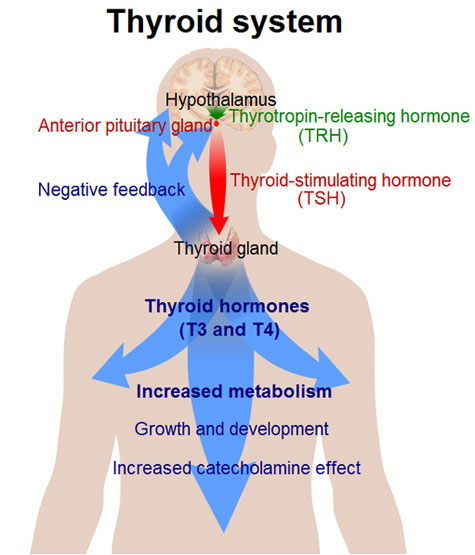
The diagnosis for hypothyroidism and hyperthyroidism includes the estimation of levels T3 and T4, the thyroid hormones and TSH level. In hypothyroidism, there is decrease in the thyroid hormones level ‘“ T3 and T4 and increase in the levels of TSH. In hyperthyroidism, there are increased levels of thyroid hormones T3 and T4 and decrease in the levels of TSH. TSH is thyroid stimulating hormone.
SUMMARY:
1. Hyperthyroidism is increased levels of thyroid hormones whereas hypothyroidism is decreased levels of thyroid hormones.
2. Hyperthyroidism can lead to thyrotoxicosis and grave’s disease whereas hypothyroidism does not produce those diseases.
3. There is faster metabolism in hyperthyroidism while there is a slow metabolism in hypothyroidism.
4. Hypothyroidism is treated by supplements of thyroid hormones and hyperthyroidism is treated by anti-thyroid drugs.
5. Hypothyroidism shows decreased levels of T3 and T4 and increased levels of TSH whereas in hyperthyroidism, there is an increased levels of T3 and T4 and a decreased level in TSH.
- Difference Between Cell Wall and Cell Membrane - December 19, 2009
- Difference Between Evaporation and Boiling - December 19, 2009
- Difference Between OCD and OCPD - December 19, 2009
Search DifferenceBetween.net :
 Email This Post
: If you like this article or our site. Please spread the word. Share it with your friends/family.
Email This Post
: If you like this article or our site. Please spread the word. Share it with your friends/family.


II have been diagnosed with hypothyroidism and have all the symptoms above for it, except, I have been unintentionally losing weight, and too much of it. I am way under-weight and can’t gain it back, no matter what I do. I was prescribed 25mcg levothyroxine, and have lost even more weight. I look very unhealthy and thin. I question my doctor whether or not I have hyperthyroidism already and have been given an excess amount of hormones because when I had my labs done, the result was that my T4 was too low, which would mean that my thyroid was OVERACTIVE. once the labs were sent to my doctor, she said that the labs read that my T4 was too high. I am switching doctors because this doctor has messed up a lot in the past and isn’t very caring or willing to listen to her patients. She also seems to not know what she’s doing and is stumped when I ask her medical questions (i’ve taken a year of medical classes). If anyone else is experiencing this, get more than one opinion. Your health is never worth risking.
Hey, My name is Josie. I have Hyperthroyidism. I had Graves dieases when I was 5 years old, and was expected to die in a month. I could not remember anything. I would be told to do something and forget to do it straight away. I had to have blood tests every 3 weeks, then every 6 weeks then every two months. That went on for 2 years. 1 year ago it came back. I was allways cold, grumpy and depressed looking. I got such painful periods, so painful that I would vomit. The worst year of my life. I gained weight and became a different person.
I have been on a natural thyroid for a month and I feel safe about this product.It is a natural whole gland supplement. You can try to check it out too.
I’ve just found out that I have hyperthyroidism and just got my medicine today,but still not sure what is the best way to go with this problem,what is the supplement you’re you spoke of and where do I get it.
I recommend trying tirosint it’s made by akramark and it’s a natural thing my mom takes it and she is doing well, I am going in this month to see an endocrinologist I have cystic growths on both sides of my thyroid and mild enlargement on the left lobe, hopefully everything is in the clear and they only have to put me on meds and not have to remove it… I’m nervous, but certain I will be fine, my thyroid levels were a 4 which is hella high considering they should be a point something for my height and weight… So try that medication, it’s not cheap, but it is a very good medication, considering my mother couldn’t take synthroid it made her severely sick
i am one of the graduated students i was searching thyroiditis, Hypo and Hyperthroidism so as to Know clinical features, pathophysiology, Etiology, invetigations and management i saw here while iam self studies, if you can help for more information please contact me.
I had thyroid surgery last year because of hyperthyroidism. Now I have no weight problem. I can eat anything I want.Is this normal?
Kevin
My Q is about this answer—-(I have been on a natural thyroid for a month and I feel safe about this product.It is a natural whole gland supplement. You can try to check it out too.)
I would like to know the medicine and where can i get the medicine. Please send me all the details. U can reach me by my Email.
alluries@gmail.com
Thank u Madhu
Can you have symptoms of both hypo and hyper thyroid problems. My T3 and T4 looks pretty good but I have no TSH. It’s below zero. My hair is falling out and my eyebrows are gone. I have great puffiness underneath the eyes, but my eyes don’t bulge. I’m extremely constipated. I have also been checked for the amount of thyroid T4 that I can make into T3. My test results I’m told look OK. I take cytomel and t4
I am a final year nursing student hoping to write my final year exam. Am glad i find this page,it has really helped me a lot in all i need to know about hyper and hypothyroidism. Thanks to admin of this wonderful page.